



July’s manufacturing sentiment reads like a dinner party where the kitchen is still sending out plates but the guest list has quietly thinned. Euro-area and Japanese production hit four- and twelve-year highs, much of it cooked from backlog rather than fresh orders, while the global Manufacturing PMI slipped to 52.1. Asia’s semiconductor and AI cycle is doing the heavy lifting. For machine vision, demand is real but increasingly Asian, electronics-led – and newly taxed by a memory-chip squeeze.
Regional Trends in Industrial Output
Industrial output data run through June 2026, and the primary regions have split into two speeds. India (+7.3% YoY) and China (+5.3%) set the pace, with Korea (+5.8%) and Japan (+4.8%) snapping back hard from a soft May. The US ground out +1.1%, its weakest of the quarter. Europe simply stopped: +0.1% for the EU and a flat 0.0% for Germany, which has spent six months oscillating around zero. Capacity is being added in Asia; in Europe it is being maintained.
Industrial production, % change year on year, primary regions (CN, JP, KR, EU, US), 12 months to May 2026. Source: Vision Markets economics database.
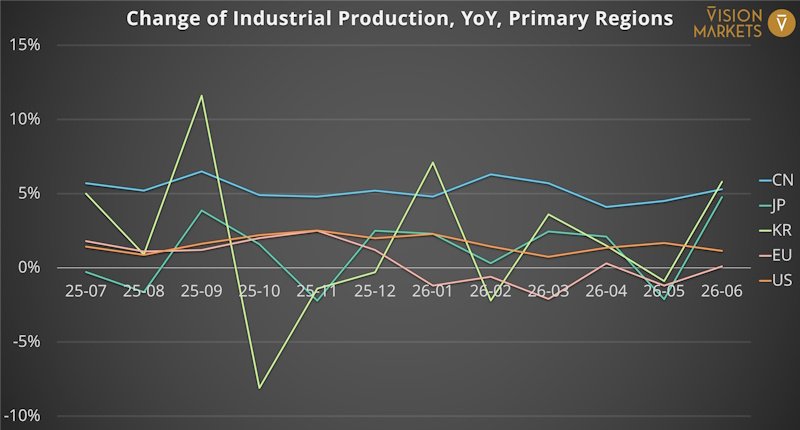
Industrial production, % change year on year, primary regions (CN, JP, KR, EU, US), 12 months to May 2026. Source: Vision Markets economics database
Sentiments in the Global Manufacturing Sector
Global: Twelve Months Up – With the Engine Easing Off
United States: A Steady Headline With Soft Ground Underneath
The US M-PMI held at 53.9 – a headline that flatters the detail. Production grew at its slowest pace since March, new orders eased for a third straight month, exports fell again under tariffs and confidence sank to a nine-month low. Fast-payback productivity and yield projects still get approved; greenfield capacity is being politely postponed.
Eurozone: Best Production in Four and a Half Years – Bought on Backlog Credit
The eurozone M-PMI rose to 51.9 and its output index to 52.9, a 52-month high. Unlike the US, Europe prints its problem openly: new orders rose only marginally, export orders fell again, backlogs were drawn down and employment kept falling. Germany stands out at 52.2 on the steepest export gain since February 2022 – panellists named defence spending and data-centre build-outs as the sources, while France and Spain stagnated. Two verticals are writing cheques here; the rest of the continent runs its lines widely on orders booked months ago.
China: Eight Months Up, and a Warehouse Full of Inputs
China eased to a four-month low of 50.9, still an eighth month of improvement. The caveat is the inventory line: stocks of purchases have risen for eight consecutive months, the longest run since 2006-07, and firms cut purchasing for the first time since November 2025. Should that build unwind, Chinese line-level capex – the biggest source of machine vision unit volume – slows before the headline admits it.
Japan: The Best Factory Month Since 2014
Japan printed 54.5, a seventh consecutive improvement, with output expanding at the fastest rate in nearly twelve and a half years and panellists pointing squarely at semiconductors and AI demand. Backlogs are building at the sharpest pace since February 2014 despite solid hiring: a plant that cannot recruit its way out of a queue starts pricing inspection equipment instead.
South Korea: Semiconductors and Cars Finally Pulling Together
Korea improved to 53.1, among its strongest readings in four years, as semiconductor and automotive demand lifted output and new orders and export sales grew at the fastest pace since April 2021 – the cleanest short-cycle read for vision demand in back-end, display and battery inspection.
India and ASEAN: Cooling From Excellent to Merely Good
India slipped to 53.5, its lowest since August 2021 – a headline that reads worse than the substance. Consumer goods were the weak spot, while capital and intermediate goods producers posted stronger gains: precisely the mix that precedes automation investment. ASEAN rebounded to 52.8, a five-month high.
The Memory Tax: A Component Bill Nobody Budgeted
One theme cuts across every country survey and lands on vision suppliers directly. German panellists flagged electronic parts as in short supply, US firms reported near-worst vendor performance in four years, and global lead times have lengthened for twenty-six straight months. Zebra alone absorbed some USD 120 million of memory-cost headwind this year. Many Machine Vision components host DRAM inside – customer should budget for price and lead-time letters in Q4.
S&P Global Manufacturing PMI, primary regions, 12 months to July 2026. Above 50 = expansion versus previous month. Source: Vision Markets economics database.
Disclaimer: Purchasing Managers’ Index™ and PMI® are either trade marks or registered trade marks of S&P Global Inc. or are licensed to S&P Global Inc. and/or its affiliates. Intellectual property rights to the PMI data referenced above are owned by or licensed to S&P Global and/or its affiliates. The J.P.Morgan Global Manufacturing PMI® is compiled by S&P Global in association with ISM and IFPSM; the China General Manufacturing PMI is compiled by S&P Global for RatingDog; the India Manufacturing PMI is sponsored by HSBC; the Germany Manufacturing PMI is compiled in association with BME. All figures cited are July 2026 readings and are reproduced here for commentary purposes. S&P Global accepts no responsibility for conclusions drawn in this bulletin.
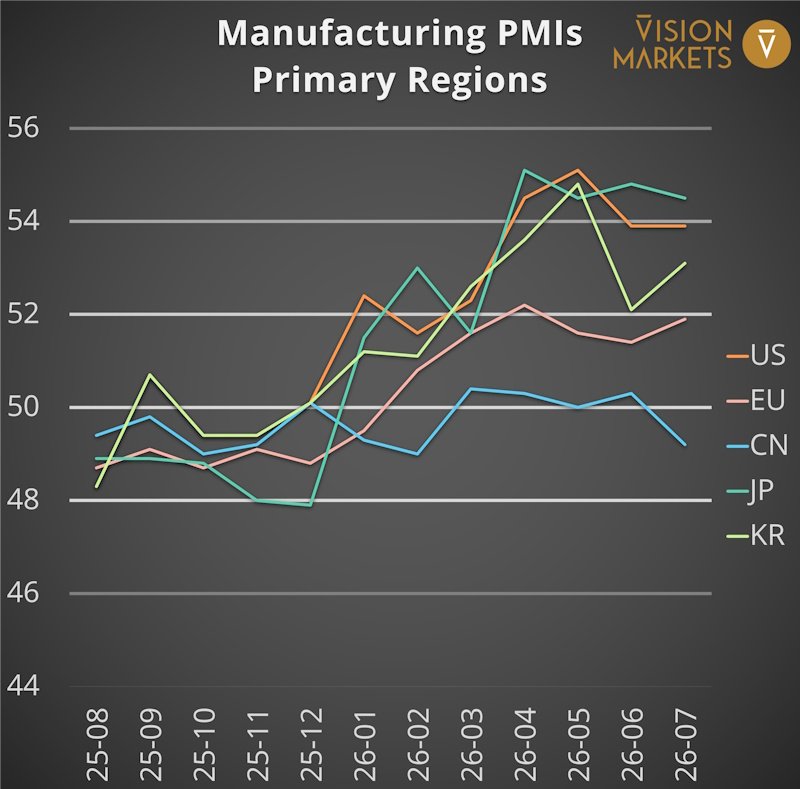
S&P Global Manufacturing PMI, primary regions, 12 months to July 2026. Above 50 = expansion versus previous month. Source: Vision Markets economics database.
Revenue Trends of Key Players
Accumulated TTM revenue of the tracked listed players reached USD 27.9 billion at end-Q2 2026, up 11.0% year on year. The real move is in the consensus: compared to our analysis from four weeks ago, the full-year 2026 aggregate forecast was lifted from 12.9% to 16.8%. Keyence carries most of it, vaulting from 22.2% to 29.9% after a quarter that beat on sales and margin – an implied second half far above the 9.9% delivered through June, and worth watching sceptically. Cognex went from 11.6% to 15.2% on a record USD 291 million quarter, Zebra from 12.3% to 15.3%, Basler from 24.4% to 28.1%, TKH from 5.0% to 10.9% – though TKH’s momentum is overwhelmingly Electrification (+33.3% organic in H1), with Vision Technology up a respectable 12.1% and Automated Machinery down 5.7%. More a cable story than a vision story.
The league table barely moved, which is its own message. The fastest three for 2026 remain Chinese – Orbbec (+68.8%), Luster (+36.8%) and OPT (+32.9%) – riding robotics, physical-AI perception and domestic substitution; Orbbec also took the sharpest downgrade, from 91.1%. The laggards are familiar: Vieworks (+1.4%), four-fifths medical detectors; Datalogic (+4.4%), hostage to flat retail capex; and Hamamatsu (+5.9%), which guides to +12.7% in yen – that gap is rather currency, less demand. On last reported actuals the order flips: OPT (+47.3%), Basler (+40.2%) and Orbbec (+26.9%) led; Hamamatsu (+3.3%) trailed.
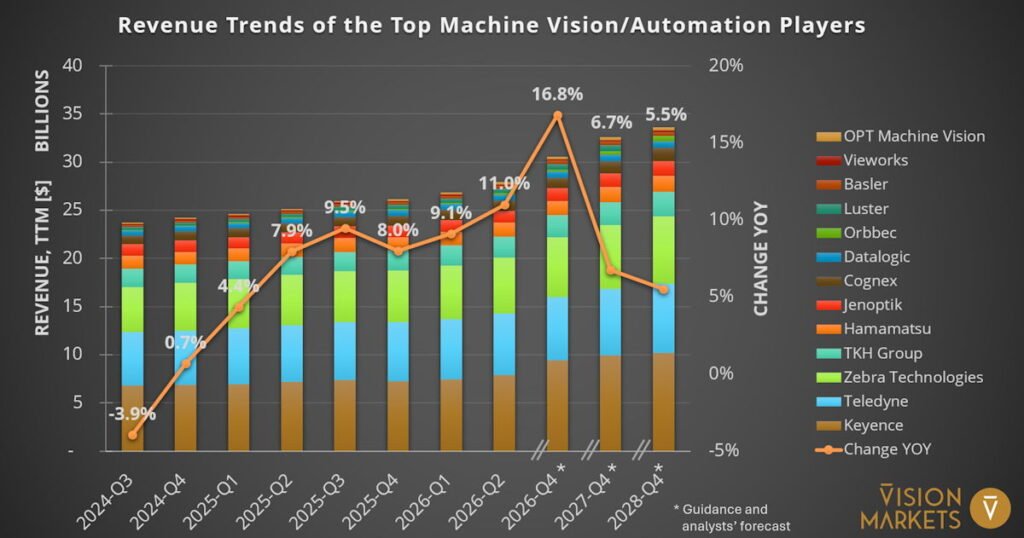
Trailing-twelve-month revenue of listed machine vision players in USD, with consensus estimates for full years. Source: Vision Markets company database.
Where This Leaves Your 2027 Plan
Demand is real, but it has an address: Asian electronics and semiconductor back-end, defence and data-centre supply chains, productivity retrofits in the West. Everything else carries a longer sales cycle than forecasts assume. If you want to pressure-test your pipeline against these signals – which regions and verticals to staff up, which to hold, how to price against a rising component bill – talk to us.
| What We Will Watch Out for in the Coming Months |
| Whether Europe’s backlog-funded output survives contact with its thin order book; whether China’s eight-month input-stock build unwinds into weaker line capex; and whether memory pricing hardens from a cost headline into a worsening lead-time problem. |
Author:
Dr.-Ing. Ronald Müller, Managing Advisor Strategy and M&A in Machine Vision, Vision Markets