




In a Nutshell:
September broke the pattern of the past two years. The global Manufacturing PMI hit a 55-month high, every eurozone country expanded for the first time since 2022, and the US jumped to 55.9. Output and orders are being driven by AI infrastructure and defence equipment. The catch is on the cost side: input and selling prices re-accelerated everywhere, and both the Fed and the ECB are back in the conversation. For vision suppliers, demand is no longer the question. Capacity and price are.
Followers of our social media profiles and members of our VisionCrunch community, are already familiar with the economic indicators we use to monitor the manufacturing industry by country. If you are not, please check out this explanation of Manufacturing PMI and year-over-year change in Industrial Output.
Purchasing Managers’ Index™ and PMI® are either trademarks or registered trademarks of S&P Global Inc or licensed to S&P Global Inc and/or its affiliates.
Regional Trends in Industrial Output
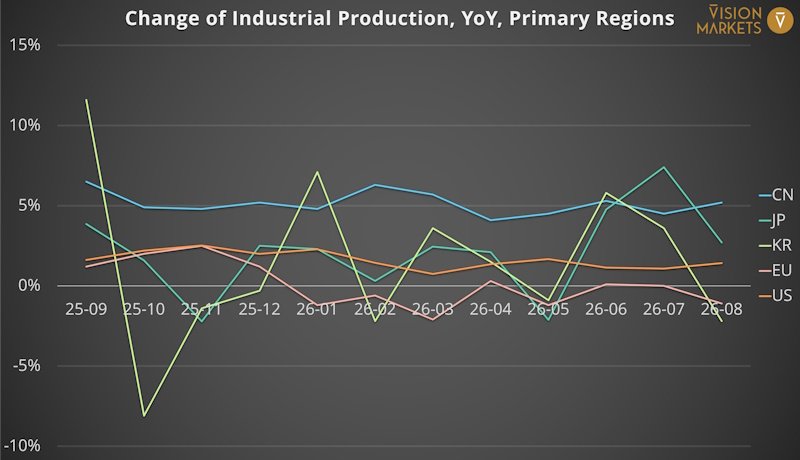
Output data now run through August, and the divergence is widening. India leads at +8.0% year on year, its best of 2026, with China steady near +5.2%. Germany finally delivered: +2.3% after seven months around zero. The euro area still shrank 1.1%, so Germany is pulling against its own continent. Two oddities: Korea swung from +5.8% in June to -2.2% in August despite a booming PMI, and Japan gave back most of its July spike. Hard data stay noisier than sentiment.
Sentiments in the Global Manufacturing Sector
Global: A 55-Month High, and the Reason Is Written on the Invoice – The J.P.Morgan Global Manufacturing PMI (M-PMI) jumped to 53.0, its best since February 2022. Production grew at the fastest pace since July 2021, new orders at the fastest in 55 months, employment at a 52-month high. S&P Global names the drivers outright: spending on AI infrastructure and defence equipment, plus precautionary stock building. The caveat is on the cost front: input and output prices both accelerated.
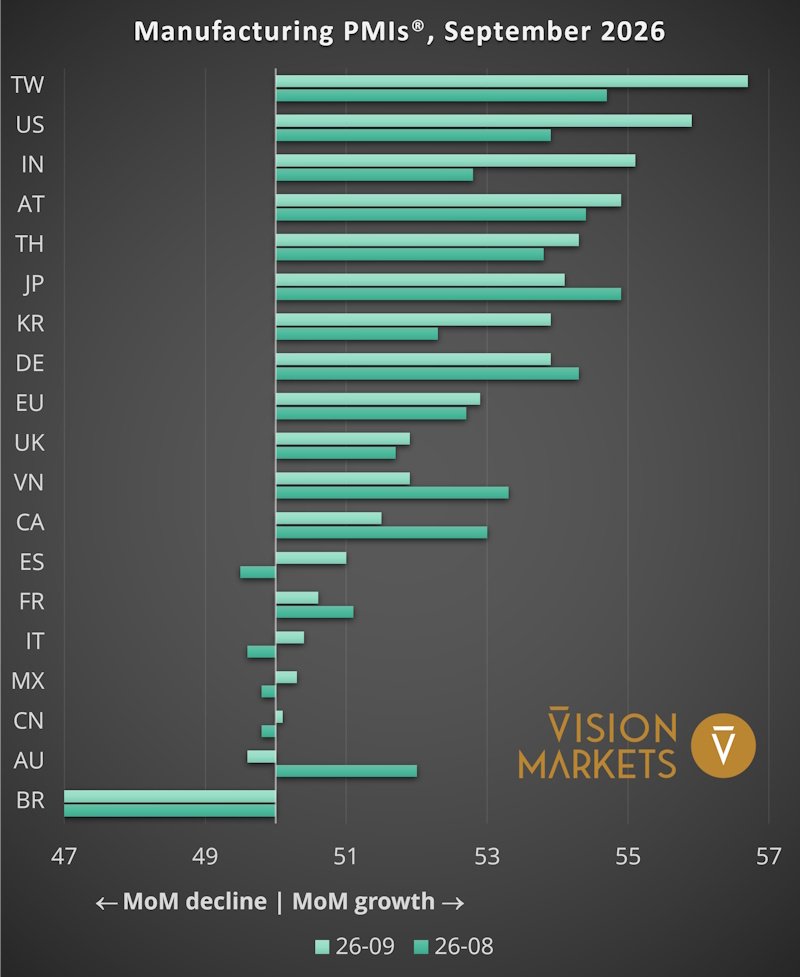
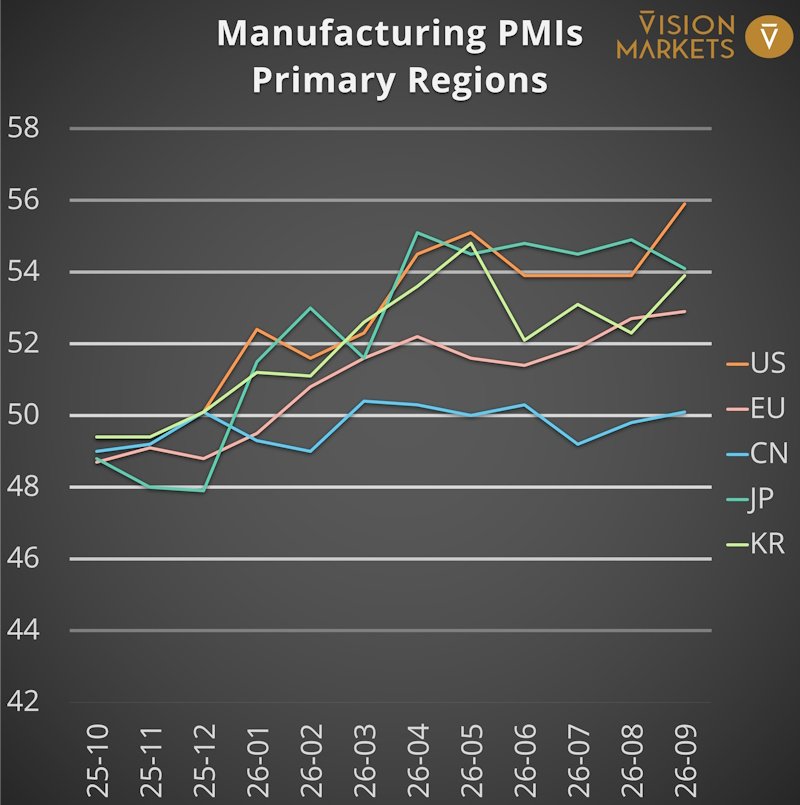
United States: The Strongest Factory Month Since 2022 – The US M-PMI surged from 53.9 to 55.9, the strongest since May 2022. Hiring hit a five-year high and backlogs climbed for a seventh month. Analysts pinpoints where: investment in machinery and equipment, much of it AI-related. The frictions are physical rather than financial – lead times are the worst since August 2022, steel and electronics are scarce, exports fell for a fifteenth month on tariffs. When a factory cannot hire or buy its way out, it buys throughput.
Eurozone: All Eight Monitored Countries Expanding, for the First Time in Four Years – The euro area reached 52.9 with an output index of 53.6, a 55-month high. The real statistic is distributional: all eight surveyed member states expanded in the same month, which last happened over four years ago. Factory employment rose again, ending three years of job losses. Capital goods led, on AI and defence demand; consumer goods demand is still falling.
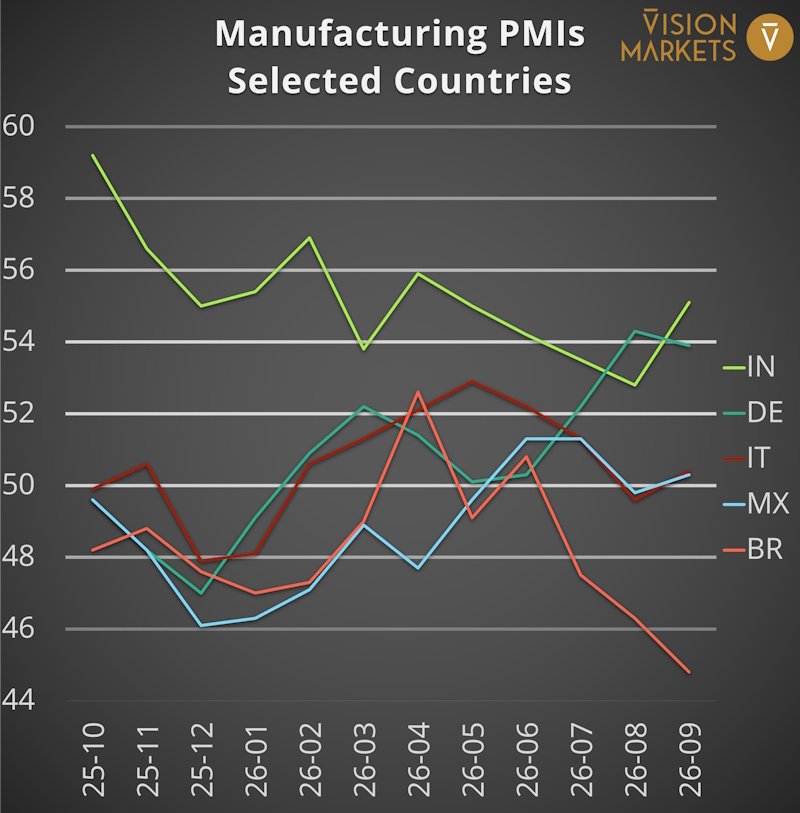
Germany: Confidence Returns, and So Does the Energy Bill – Germany eased to 53.9, a rounding error against the real news: expectations are the second-highest in four and a half years, backlogs grew at the steepest rate since April 2022, and job cutting has slowed. But input cost inflation rebounded to a June high on energy, and analysts’ read is the most useful for our industry: firms will target productivity improvements rather than hiring.
China: Both Gauges Finally Agree – Last month we explained why the official NBS index and the private RatingDog survey told opposite stories. That gap has closed: NBS reached 50.1 and RatingDog 52.1, a five-month high. Output grew at the fastest rate since April and employment returned to growth. Selling prices rose again after August’s cut, easing the margin squeeze we flagged. Chinese line-level capex now has a volume and a pricing case behind it.
Japan: Still Strong, but the Restocking Is Unwinding – Japan slipped to 54.1, a six-month low, yet closed its best quarter since Q1 2014. The cause is specific: customers are unwinding inventory built earlier in the year. Employment stays near a multi-year record and export orders near an eight-and-a-half year high. Supplier delays remain among the steepest in four years, with electronic components and AI-related technology named as the shortages.
South Korea: Export Orders at a Fifteen-Year High – Korea rebounded to 53.9 as output and new orders grew at the fastest rates in five and a half years, and export sales rose at the quickest pace since March 2011. Semiconductors and automotive drove it. Korean PMI historically leads Korean output by one to two months, so the August decline and the September surge in orders are two points in the same cycle rather than a contradiction – expect the hard data to catch up by the turn of the year.
India and ASEAN: India Reverses, ASEAN Cools Gently – Last month we reported India at a five-year low with falling employment. September erased that: the PMI jumped over two points to 55.1, a seven-month high, with hiring back. One caveat for automation buyers – capital goods was the weakest of the three sub-sectors. ASEAN eased to 52.1 as Middle East tensions and oil prices trimmed expectations.
Revenue Trends of Key Players
After two months of heavy revision, the consensus has gone quiet. Full-year 2026 growth for the tracked vision and automation players sits at 13.8%, a rounding error from September’s 13.9%, with 2027 at 9.6%. Accumulated TTM revenue was USD 27.9 billion at end-Q2, up 10.9%. A flat month after a violent one is its own signal: the analysts have stopped arguing with themselves.
The 2026 leaders are unchanged – Orbbec (+57.5%), OPT (+34.0%) and Luster (+28.8%), all Chinese. OPT’s half-year filing shows what the headline hides: revenue up 32.5%, net income up only 17%. Share is being bought with margin. The laggards have changed, and that is the news. Vieworks escaped the bottom after a six-point upgrade; the new trio is Datalogic (+3.2%), Jenoptik (+6.9%) and Teledyne (+7.3%). Read the latter two carefully, because our table mislabels them: Jenoptik lifted its 2026 guidance on an 85% jump in semiconductor orders, and Teledyne raised revenue guidance by USD 120 million. On last-reported actuals the ranking flips: OPT (+47.2%), Basler (+39.9%) and Luster (+30.4%) led.
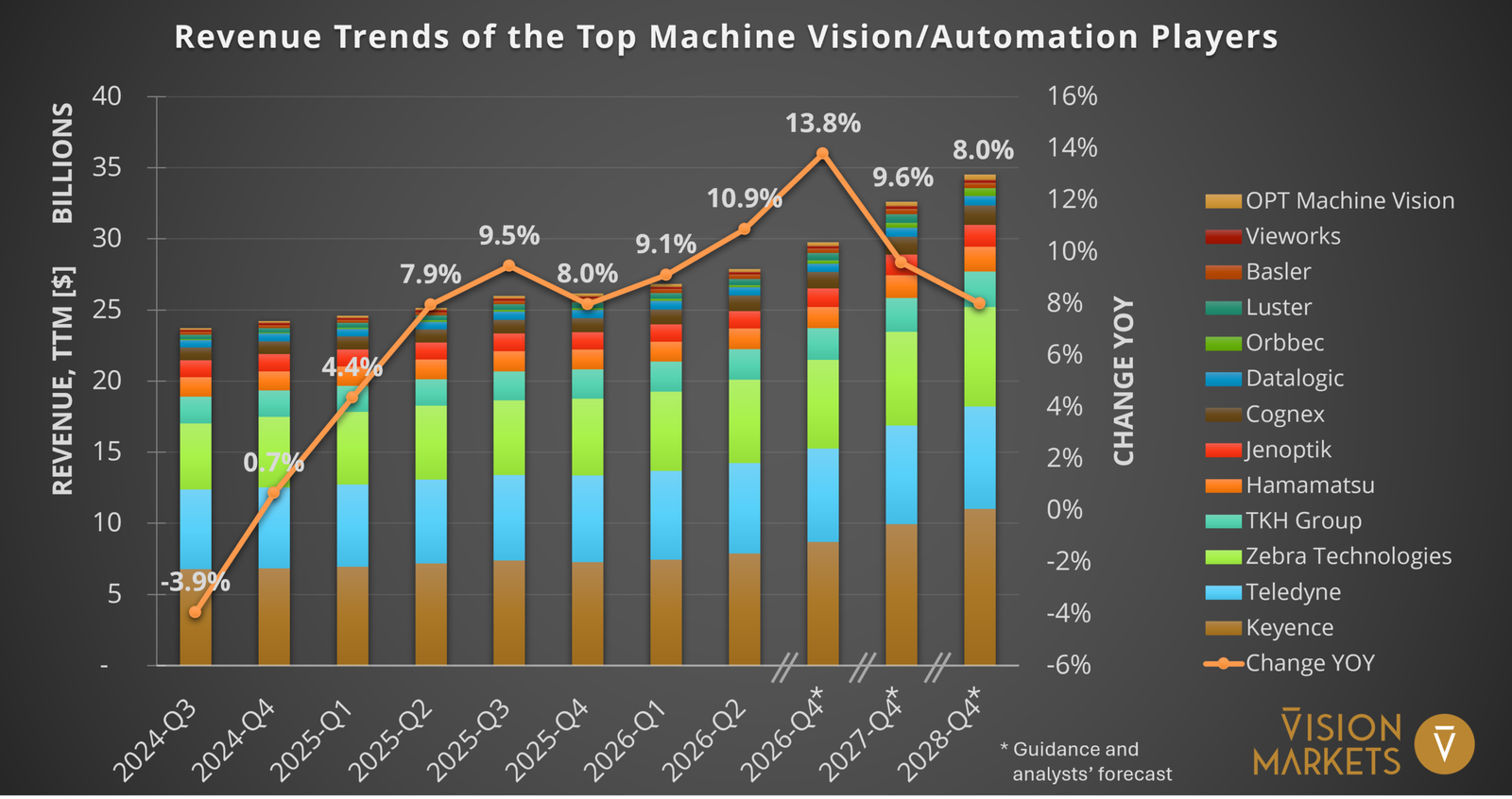 Trailing-twelve-month revenue of the listed machine vision and automation players in USD, with guidance and analysts’ forecasts for the full years. Source: Vision Markets company database.
Special: Semiconductor Equipment Is Running a Different Cycle Entirely
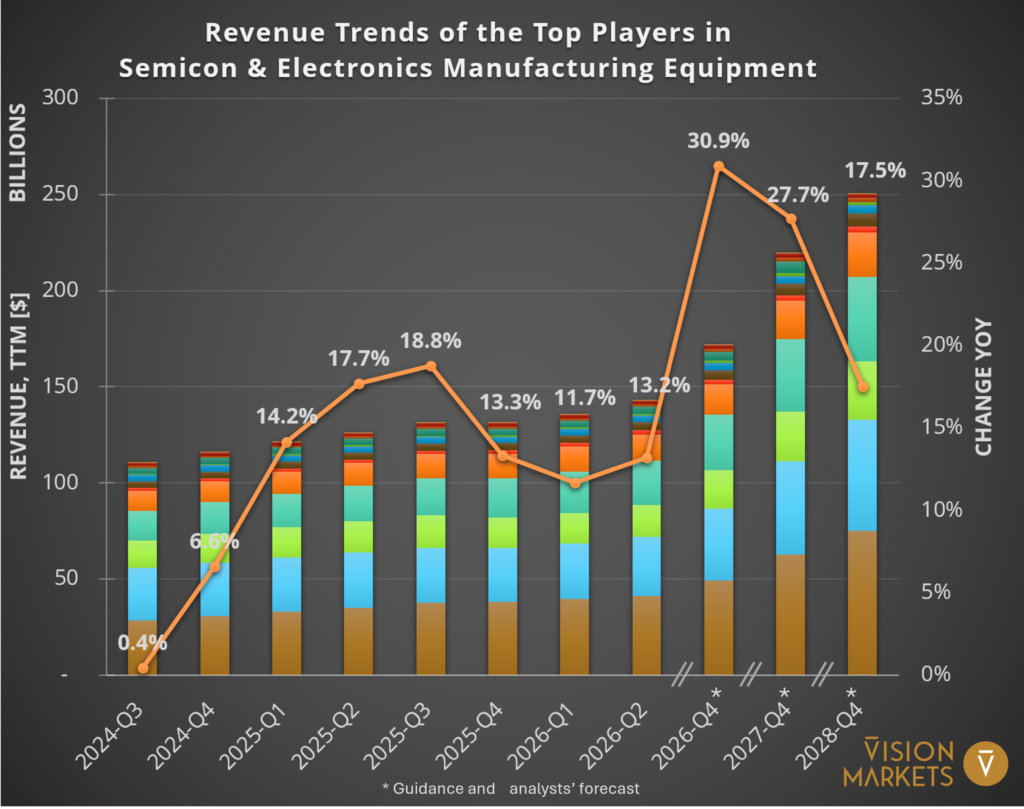
Last month we measured defence. This month we turn to the sector that sits traditionally closer to our own technology, and the numbers are of a different order. The fourteen tracked semiconductor and electronics equipment makers booked USD 143 billion of TTM revenue at end-Q2 2026, up 13.2% year on year. Consensus for full-year 2026 is +30.9%, followed by +27.7% in 2027. If that holds, the sector grows from USD 132 billion to USD 220 billion in two years. Such massive growth and even higher expectations are equally fuelling the boom Machine Vision revenues mentioned before.
The leaders are where AI packaging lives. Kulicke & Soffa is forecast at +80.5% for 2026 on chiplet and HBM bonding, Onto Innovation at +43.2%, LAM Research at +41.2% and ASM Pacific at +38.0%. ASML (+29.8%), Applied Materials (+32.0%) and Tokyo Electron (+27.8%) cluster just below. LAM has raised its 2026 wafer fab equipment forecast to the low USD 150 billions from USD 140 billion, expects advanced packaging revenue to grow over 70% this year, and calls the industry meaningfully undersupplied with eight to ten new fabs due by end-2027.
Three observations for vision suppliers. First, the inspection and metrology names inside this group are machine vision businesses by any honest definition, and they are growing at 24% to 43%. Second, the laggards are the ones furthest from AI: Viscom at +1.3% and TOWA at +6.7% both serve electronics assembly rather than advanced packaging. Third, and most soberly, a 30.9% full-year print requires a second half far above the 13.2% delivered through June. We flagged exactly that shape in our own sector in August, and the analysts spent September walking it back – the ongoing reporting period on 2026-Q3 will be especially insightful.
What To Do While Everyone Else Is Celebrating
The demand question is widely settled for now, if your business is diversified into the right target market. So, let’s spend your attention elsewhere. Price first: cost and selling-price inflation turned back up in every major survey, so fix your 2027 terms before winter. Then lead times, because the supplier who can quote a credible date will take business from one who cannot. Then mix: if your roadmap does not touch semiconductor back-end, advanced packaging or defence, you are selling into the slower half of a two-speed market. If you want help working out which half your pipeline sits in, talk to us.
What We Will Watch Out for The Coming Months
Whether the re-acceleration in input and selling prices forces central banks to act, and what that does to capex approvals; whether Korea's hard output data catch up with its record export orders; and whether the semiconductor equipment sector delivers the second half its 30.9% forecast now requires.
Where This Leaves Your 2027 Plan:
Demand is real, but it has an address: Asian electronics and semiconductor back-end, defence and data-centre supply chains, productivity retrofits in the West. Everything else carries a longer sales cycle than forecasts assume. If you want to pressure-test your pipeline against these signals – which regions and verticals to staff up, which to hold, how to price against a rising component bill – talk to us.