




In a Nutshell:
October cooled by a notch, not by a season. The global Manufacturing PMI eased to 52.6 from its September peak, while input prices and delivery times got worse almost everywhere. Factories reacted the way engineers would: they built safety stock. The third-quarter reports of the listed vision players show the supplier side: orders are growing much faster than revenue, analysts lifted their 2026 growth forecast from 13.8% to 15.8%, and those who can deliver are raising prices.
Followers of our social media profiles and members of our VisionCrunch community, are already familiar with the economic indicators we use to monitor the manufacturing industry by country. If you are not, please check out this explanation of Manufacturing PMI and year-over-year change in Industrial Output.
Purchasing Managers’ Index™ and PMI® are either trademarks or registered trademarks of S&P Global Inc or licensed to S&P Global Inc and/or its affiliates.
Regional Trends in Industrial Output
September output figures are still missing for the euro area and Japan, so we skip this section this month. For the latest full picture, please see our October bulletin. The complete third-quarter data will follow in December.
Sentiments in the Global Manufacturing Sector
Global: Still Growing, Now With a Waiting List – The J.P.Morgan Global Manufacturing PMI (M-PMI) slipped from 53.0 to 52.6, its fifteenth month above 50. Output rose in 19 of 29 countries, and makers of investment goods shared in the growth. The bad news sits in logistics: supplier delivery times lengthened for the 29th month in a row, input costs rose at the fastest pace since June, and backlogs grew for a ninth month because of delays and capacity limits. Expectations for future output remain subdued.
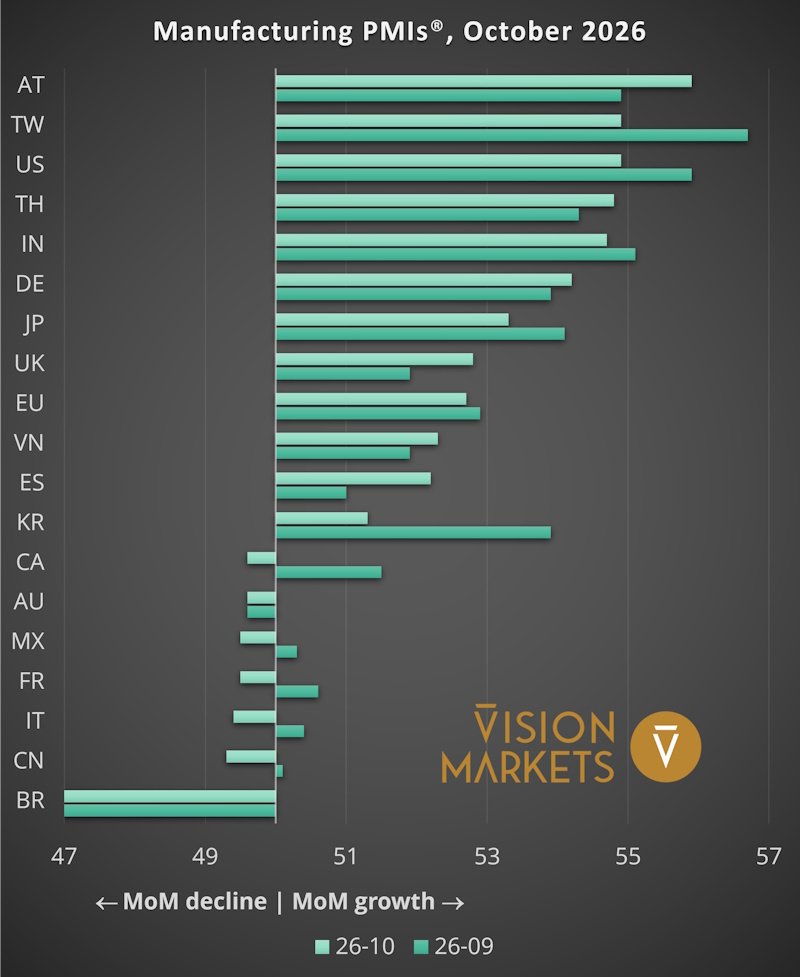
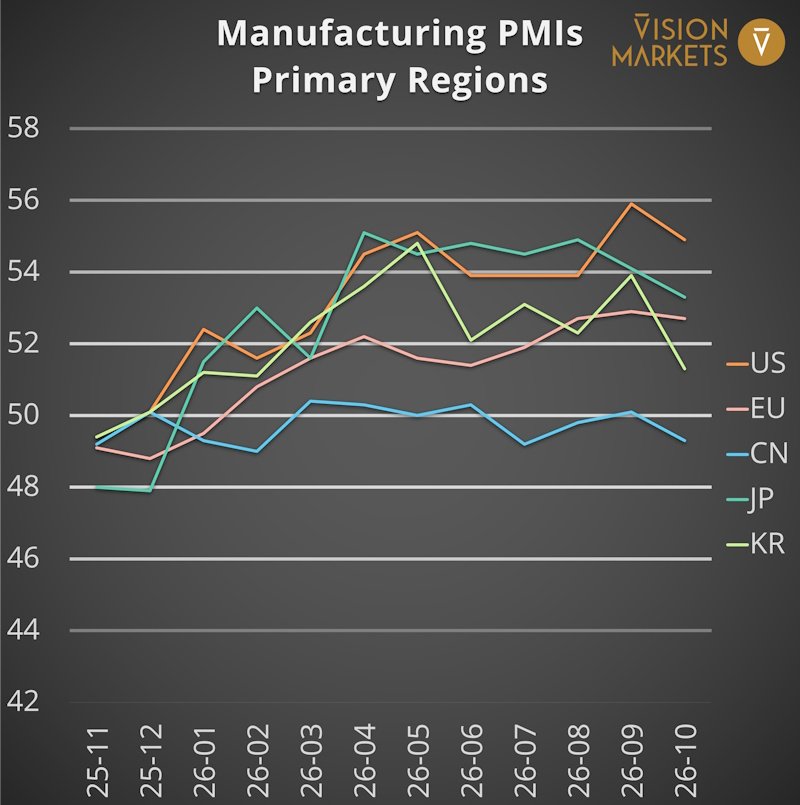
United States: Hiring Like 2021, Pricing Like 2022 – The US M-PMI eased to 54.9 from 55.9. New orders grew at the slowest rate since March, yet factories added staff at the fastest pace in five and a half years. Delivery delays are the most widespread since 2022, above all for AI data center parts. Producers passed the costs on: selling prices rose at the steepest rate since September 2022. One small surprise: export orders grew for the first time since June 2025.
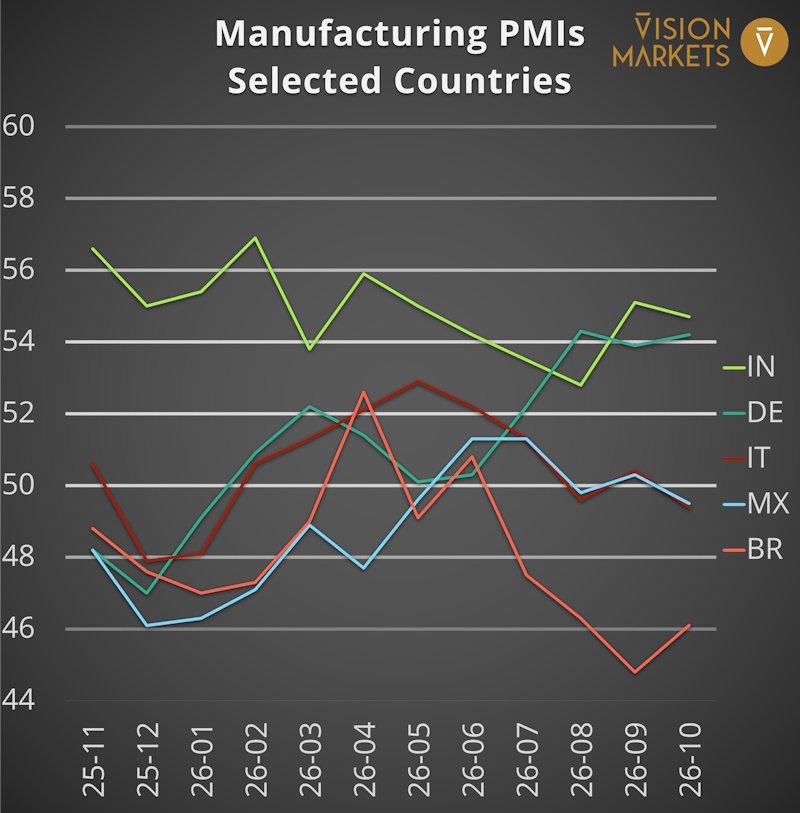
Eurozone: The Full House Lasted One Month – In September all eight surveyed countries expanded. In October France (49.5) and Italy (49.4) dropped out again, and the euro area eased to 52.7. The core stays firm: Germany rose to 54.2, Austria leads at 55.9, and export orders grew at the fastest rate in over four and a half years. German factories cite defense and infrastructure spending, report shortages of electronic components, and built up input stocks for the first time in almost four years.
China: One Country, Two Readings, Again – The agreement between the two Chinese surveys did not survive October. The official NBS index fell back to 49.3, while the private RatingDog survey held at 52.0. RatingDog shows output rising at the fastest rate since April, led by investment goods. The volume has a cost: selling prices fell for the second time in three months, and export prices fell for the first time in nearly a year. China is also the one place where deliveries got faster.
Japan: Slower Orders, Fuller Warehouses – Japan eased to 53.3, a seven-month low, as output and new orders grew at their slowest rates since March. Little else looks weak. Hiring stays close to its fastest pace in eight and a half years, backlogs grew faster, and input stocks rose at the steepest rate in almost four years as firms bought ahead of further price increases. Semiconductor-related demand remains the main source of new orders.
South Korea: Sentiment Came Down to Meet the Data – Last month we expected Korea’s hard data to catch up with its PMI. September output did recover to +1.2% year on year, but the PMI then fell from 53.9 to 51.3, the weakest since February. Material shortages and high costs held back production, car orders softened, and employment fell for the first time in four months. Chip demand still carries the order books, and the optimism.
India and ASEAN: Record Orders and a Hint for Automation Sellers – ASEAN is the exception to the cooling: its PMI rose to 53.1 as new orders and backlogs both grew at record rates on AI-related demand. India eased to 54.7, with export orders at a six-month high and the mildest selling-price inflation in almost four years. Capital goods makers cut staff, the weak spot we flagged in October. Yet Indian firms named demand for industrial automation as one reason for their optimism. We will take that.
Revenue Trends of Key Players
The third-quarter reports moved the numbers. Trailing-twelve-month (TTM) revenue of the thirteen players we track reached about USD 29.3 billion by end-September, up 12.6% year on year. For Datalogic, TKH and Vieworks, third-quarter figures were not yet available in our database and are estimated. Analysts raised their growth forecast for 2026 from 13.8% to 15.8% and for 2027 from 9.6% to 9.8%. The largest upgrades went to Basler, Hamamatsu and Keyence, whose half-year sales in Asia rose 56%.
Basler lifted nine-month sales by 35% and orders by 62%, raised its guidance for the second time, and names a production stop at a key image-sensor supplier as a risk.
At the other end stand Datalogic (+3.2%), Jenoptik (+7.4%) and Teledyne (+8.5%). Datalogic’s nine-month figures were not available at the time of writing; in the second quarter its sales in the Americas fell 25%. Jenoptik is slow for a better reason: orders rose 41% in nine months while revenue rose 6.7%, leaving a backlog of EUR 903 million. Teledyne posted a record quarter, with Digital Imaging up 15%. Among the ten with third-quarter figures, OPT (+46.6%), Basler (+30.0%) and Luster (+16.9%) lead on TTM revenue, while Jenoptik (+2.4%), Hamamatsu (+6.3%, held back by the weak yen) and Orbbec (+7.3%) trail.
The pattern: growth sits where chips are made, packaged and inspected, and suppliers who can ship can price, as the margin gain at Cognex shows.
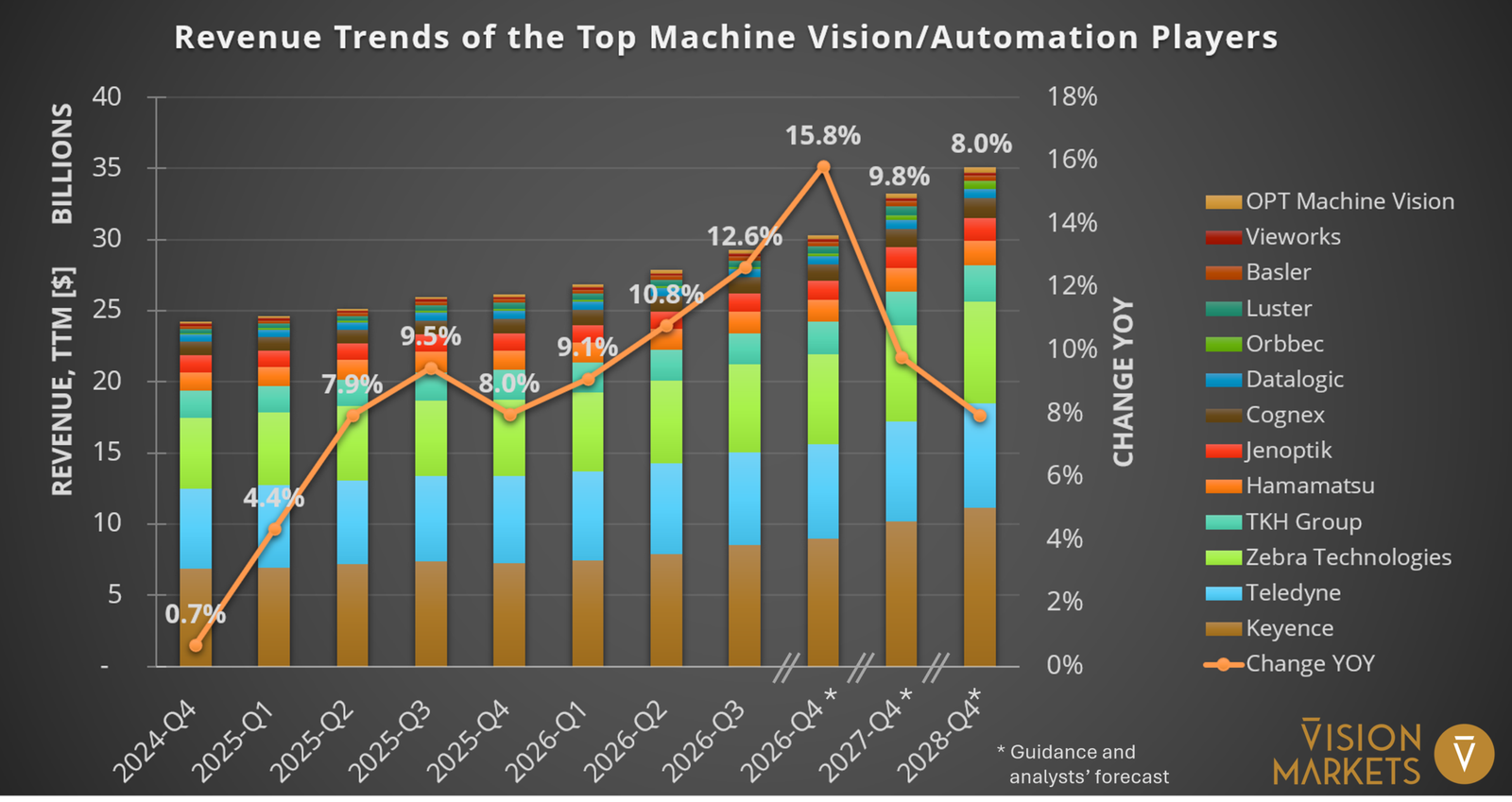 Trailing-twelve-month revenue of listed machine vision players in USD, with consensus estimates for full years. Source: Vision Markets company database.
What To Do When Your Customers Are Stockpiling
Three practical conclusions. First, check your own supply before you promise delivery dates: image sensors and memory chips are the scarce parts this winter. Second, read your order intake with care. When customers build safety stock, a part of today’s orders is borrowed from next year, and every engineer knows how a bullwhip ends. Third, if you can deliver, you can price. If you want a second opinion on your 2027 plan or your supply risk, talk to us.
What We Will Watch Out for The Coming Months
Whether the stockpiling turns into real end demand or into a correction next spring; whether the Fed and the ECB raise rates again and slow capex approvals; whether image-sensor supply recovers; and whether Chinese price cuts reach export markets.
Where This Leaves Your 2027 Plan:
Demand is real, but it has an address: Asian electronics and semiconductor back-end, defence and data-centre supply chains, productivity retrofits in the West. Everything else carries a longer sales cycle than forecasts assume. If you want to pressure-test your pipeline against these signals – which regions and verticals to staff up, which to hold, how to price against a rising component bill – talk to us.