




In a Nutshell:
Last month we called the consensus hockey stick in machine vision revenues worth watching sceptically. Four weeks later the analysts blinked: 2026 growth for the listed vision players was cut from 16.8% to 13.9%, while 2027 was lifted from 6.8% to 9.5%. Nothing was cancelled – it was deferred. Meanwhile Europe is brightening up. German factories hit a 51-month high on defence and data-centre orders, and the defence primes are now signing nine-figure cheques for series production capacity.
Followers of our social media profiles and members of our VisionCrunch community, are already familiar with the economic indicators we use to monitor the manufacturing industry by country. If you are not, please check out this explanation of Manufacturing PMI and year-over-year change in Industrial Output.
Purchasing Managers’ Index™ and PMI® are either trademarks or registered trademarks of S&P Global Inc or licensed to S&P Global Inc and/or its affiliates.
Regional Trends in Industrial Output
A short note this month. Because the August issue landed late, only a thin handful of new year-on-year output readings have arrived since – not enough to tell you anything the August bulletin did not already tell you better. The shape is unchanged: Asia adding capacity, Europe flat, the US grinding near +1%. We return to output data in October, when the summer readings are complete.
Sentiments in the Global Manufacturing Sector
Global: Thirteen Months Up, and This Time the Engine Revs – The J.P.Morgan Global Manufacturing PMI (M-PMI) rose to a three-month high of 52.3, a thirteenth consecutive month above the waterline. Output, new orders and employment all accelerated, and export orders grew for the first time since April. Last month we called the hiring line the most useful number in the release; it has now hit a three-year high. Factories believe their own order books.
United States: Same Number, Third Month, Different Problem – The US M-PMI was unchanged at 53.9 for a third month, but the composition shifted. Output growth was the weakest since February and exports fell for a fourteenth month under tariffs, while employment rose at the fastest rate so far in 2026. The catch: stock building was a key driver of both output and demand. A restocking cycle is not a capacity cycle.
Eurozone: The Best Order Book Since Early 2022 – Here is what genuinely changed this month. The eurozone M-PMI climbed to 52.7 and its output index to 53.3, a 51- and 54-month high. In August the region lived off its backlog; now it is refilling it. New orders rose at their fastest rate since early 2022, export business grew for only the second time in four and a half years, and employment stopped falling after three years of decline. Italy slipped back into contraction at 49.6 and Spain stayed at 49.5, so this is not yet a continental boom.
Germany: Defence and Data Centres, Named on the Order Slips – Germany is the engine of that turn, rising to a 51-month high of 54.3, with new orders growing at the quickest rate since February 2022. Panellists named the drivers explicitly: defence spending, data-centre build-outs and stockpiling. Two cautions: employment is still falling, and supply chains worsened on AI-boom component bottlenecks and – a very European detail – low water on the Rhine.
China: Two Different Chinas in One Chart – The chart below plots the official NBS gauge, which read 49.8 in August and remains below 50. The private RatingDog survey, weighted toward smaller export-oriented firms, read 51.5, a ninth month of expansion. Both are correct, and the gap is the story: state-linked heavy industry is flat while the private export machine runs. New orders rose for a fifteenth month, yet output prices were cut for the first time in 2026. Volume is not the risk here. Margin is.
Japan: The Best Order Intake Since 2018 – Japan climbed to 54.9, an eighth straight improvement. New business rose at the sharpest rate in over eight and a half years and export orders at the quickest since early 2018, with semiconductors and AI-related products named again. Employment grew at the fastest pace since February 2018. Japan has moved from capacity-constrained to hiring and buying – precisely when inspection budgets open.
South Korea: Exports at a Six-Year High, Capacity in the Way – Korea eased to 52.3, yet export sales rose at the fastest pace since November 2020. The interesting detail is why the headline softened: material shortages are hampering order completion, and finished goods inventories fell at the sharpest rate since May as products shipped straight off assembly. Demand-rich and supply-poor is the classic trigger for yield spend.
India and ASEAN: One Cools, the Other Nearly Sets a Record – India slipped to 52.8, a five-year low and a third consecutive decline, with employment falling for the first time in two and a half years. Unlike last month the capital-goods cushion has thinned; only consumer goods held up. ASEAN edged down to 52.3, but new orders rose at the second-fastest pace on record.
Revenue Trends of Key Players
Last month we flagged the consensus hockey stick as worth watching sceptically. It did not survive the last two weeks. Aggregate 2026 growth for the tracked listed players has been cut from 16.8% to 13.9%, while 2027 was raised from 6.8% to 9.5% and 2028 from 5.5% to 7.9%. Nothing was cancelled; the boom was moved a year to the right. Keyence is the whole story in one line – its 2026 estimate fell from 29.9% to 19.8% while 2027 rose from 5.3% to 14.2%, a clean twelve-month shift. Orbbec was cut from 68.8% to 56.1% and Luster from 36.8% to 27.6%, the latter also on a downward revision to its reported Q2 revenue. Actuals, by contrast, barely moved: USD 27.9 billion of accumulated TTM revenue at end-Q2, up 10.9% year on year. That is the number worth keeping. When estimates fall and actuals hold, the market is not weakening – the analysts were early.
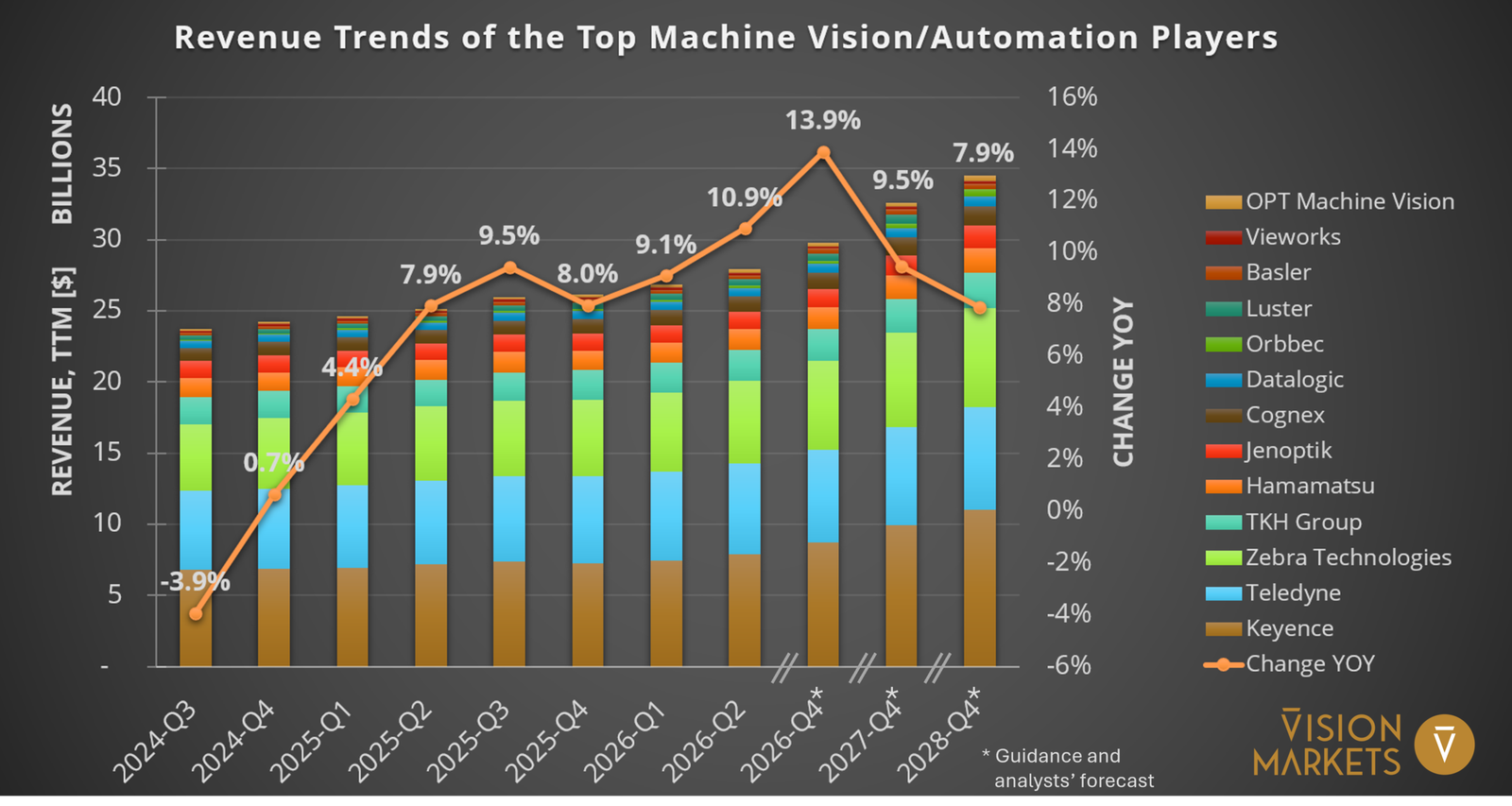 Trailing-twelve-month revenue of listed machine vision players in USD, with consensus estimates for full years. Source: Vision Markets company database
Special: Defence Is Building Factories, Not Just Backlogs
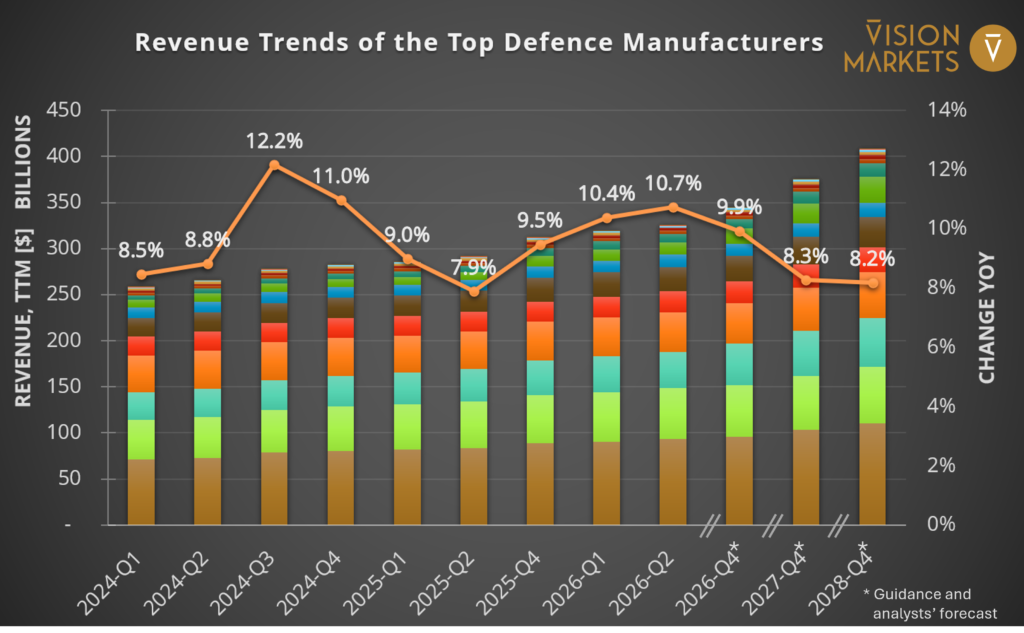
With a panel of sixteen primes and specialists, our defence index is now large enough to measure properly: USD 402 billion of TTM revenue at end-Q2 2026, up 10.7% year on year, with consensus at +9.9% for 2026 and +8.3% for 2027.
The ranking is the story. The five fastest growers are all European – Rheinmetall (+59.4%), Saab (+39.9%), Exosens (+28.9%), Hensoldt (+22.6%) and RENK (+18.2%) – while the US majors cluster between 6% and 12%. Three of those five are component and sensor businesses rather than platform primes, the tier where unit volume drives the factory. BAE Systems is the mega-cap exception, its 2026 consensus lifted to +18.7%.
What they do with the money matters more than the growth rates. BAE carries a GBP 84 billion backlog and is raising US capital spending 40% this year, explicitly on digital tools and production automation, while its Hägglunds unit (tracked vehicles) expects a 400% production increase and Saab nearly doubles its Gripen fighter jet output to 30 units a year. Rheinmetall runs capex at 8-9% of sales, its Unterlüß (DE) plant costing close to EUR 500 million for 350,000 shells a year by 2027. Lockheed Martin is committing over USD 9 billion across twenty-plus sites; its new Jessup (US) plant is built around augmented-reality harness boards, a digital-twin floor and automated material handling. Most telling for us, Exosens is spending EUR 20 million on its first US image-intensifier-tube plant in the US, producing from early 2027.
Read the buzz: series production, digital twin, automated handling, a 400% increase. Defence is converting from craft assembly to rate manufacturing – the exact transition that creates machine vision demand, in a sector where traceability is mandatory. And with an image-sensor maker among the fastest growers, this industry is not only our customer. It is becoming our peer.
Pro tip: on 7 October, we invite visitors to the Vision show in Stuttgart (DE) to join the VISION Guided Tours – Aerospace & Defence where more than 25 exhibitors will present machine vision innovations for aerospace and defence applications.
What To Do With a Boom That Moved a Year
Three things follow from this month’s data. If you sell into Europe, the order-book turn is real and the conversation has changed from defending margin to adding lines – move before the calendar fills. If you sell into defence, build the qualification and traceability case this year, because rate-manufacturing programs pick their inspection partners early and keep them. And if your 2026 plan rested on the consensus we published last month, rebuild it. If you want help deciding which regions and accounts to back, talk to us.
What We Will Watch Out for The Coming Months
Whether Europe's new orders survive the AI-driven component shortage and a low Rhine; whether China's first output-price cuts of 2026 spread beyond its home market; and whether India's cooling reaches capital goods. October opens a new quarter, so we will read the players' financial reports and refresh the forecasts.
Where This Leaves Your 2027 Plan:
Demand is real, but it has an address: Asian electronics and semiconductor back-end, defence and data-centre supply chains, productivity retrofits in the West. Everything else carries a longer sales cycle than forecasts assume. If you want to pressure-test your pipeline against these signals – which regions and verticals to staff up, which to hold, how to price against a rising component bill – talk to us.